Everyone knows about the luxury sedans from the late 2000s to the early 2010s. It was the golden era for sedans, with customers having a vast array of premium options to choose from, including the Chevrolet Cruze, Volkswagen Jetta, Honda Civic, Skoda Laura, and Toyota Corolla Altis. The public adored all these cars and was garnering commendable sales. Move a price bracket higher, and you could get the Hyundai Sonata, Toyota Camry, BMW 3 Series, Mercedes C-Class, or Audi A3. This is from a time when you could get a luxury German sedan for 30-35 lakhs.
Maruti Suzuki wanted a piece of this pie. They were the leading manufacturer in India and decided to mix things up. Maruti launched the Kizashi in 2011 via the CBU route, taking a bold step forward. Interestingly, it was discontinued only 3 years later. The Kizashi (modified) once boasted a land-speed record of 327 kph. Today, we will try to understand why the Kizashi disappeared into the shadows.
Read More: This was India’s first hot-hatch – And it’s not the Polo
Looks
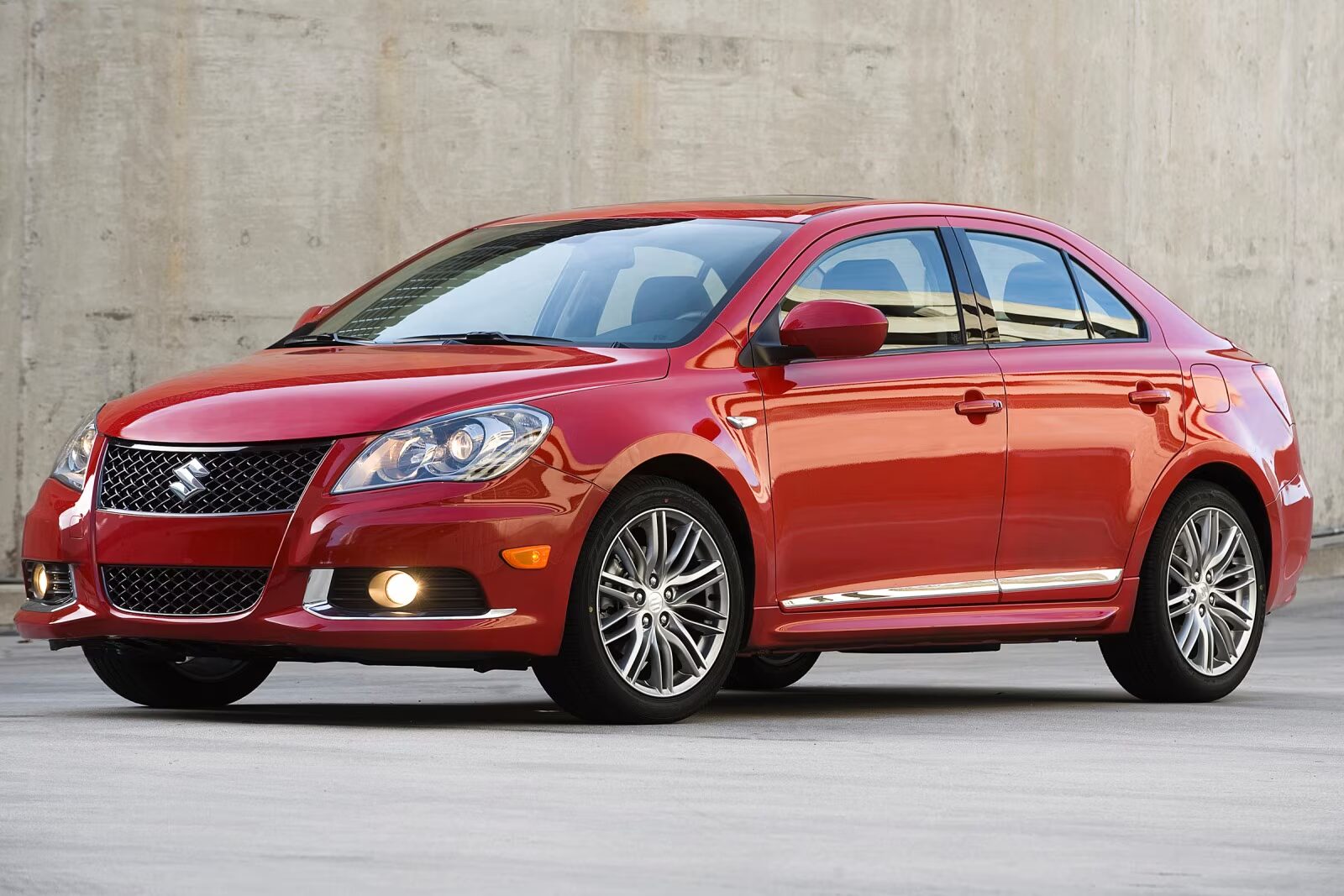
Image Source
It would come as a surprise that one of the most beautiful of the last decade was a Maruti. A sleek body matched with 17″ alloys gives it an elegant look. The difference between the Kizashi and the rest of its range was astronomical. At the time, you wouldn’t recognise that it was a Maruti if not for the badge.
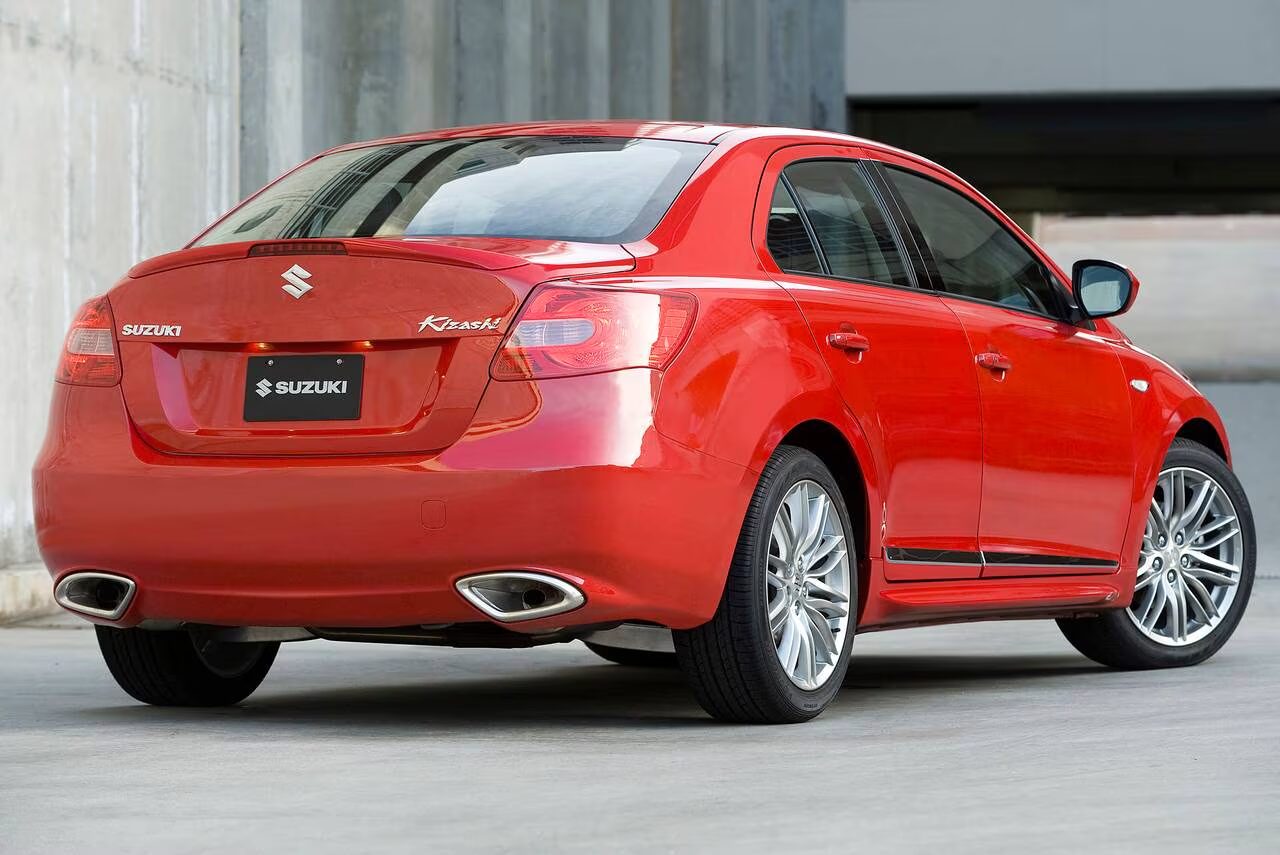
You get dual chrome exhaust tips at the back, and the boot lid is designed to mimic a lip spoiler for a sportier look. The vehicle proportions were such that you get a long 2.7-meter wheelbase without it looking ungainly. The cars of the 2010s were yet to transition from Halogen to LED lights, and that remains the case with the Kizashi. You can also see a slight resemblance to the SX4, but that is not particularly a negative point. You won’t find any aesthetic features that stand out, but it’s smooth and simple design language give it a sophisticated look that one looks for while buying a sedan.
It was the right combination of sporty and elegant, which gave it serious road presence. In a crowd of SUVs and hatchbacks, the Kizashi will stand out for its beauty. Looking back, most premium sedans then looked gorgeous. The design engineers needed a miracle to outshine the German and Japanese counterparts, and I would say they came pretty close.
Interior
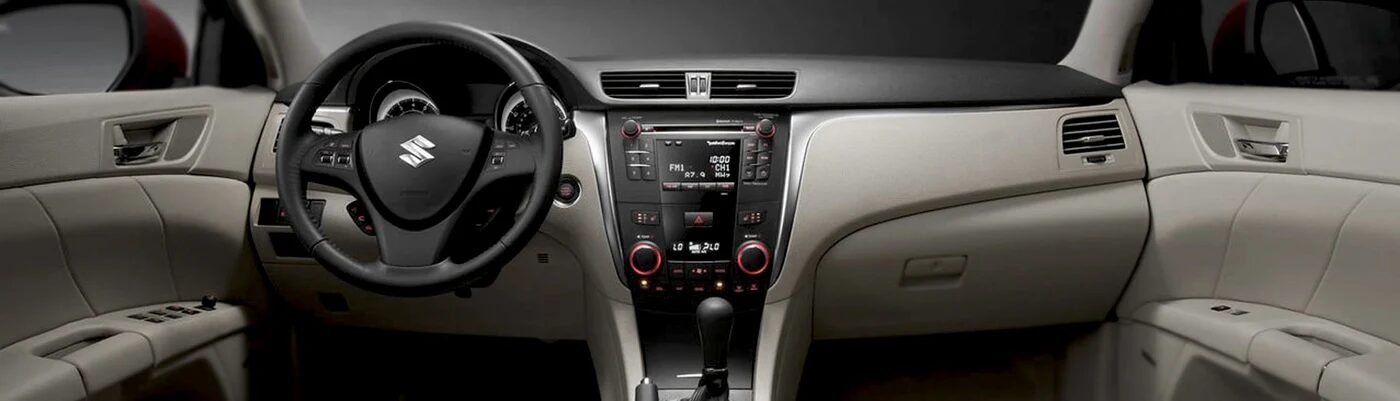
Step inside, and the Kizashi finally shows its age. It has a very typical look of the early 2010s cars with the traditional speedometer, a minuscule TFT driver’s display, a radio system and an abundance of physical buttons. The equipment list is still decent, with 6 airbags, push-button start, 10-way power adjust, and 3 memory settings on the driver’s seat, rear armrest, and leather seats. There was only one trim option, so these feature lists were standard for the Kizashi.
Notably, the build quality is top-notch and is particularly impressive when compared to other Maruti cars of the time. Dual-tone interiors and an abundance of soft-touch materials give it a plush feel, and the heavy doors are a sign of its robust build quality. The cabin is spacious with enough legroom and headroom for rear passengers.
Powertrain

Image Source
The Kizashi is powered by a 2.4L VVT Petrol engine that produces almost 180 horsepower and 230 Nm of torque. These are impressive numbers, and since it is a naturally aspirated engine, the Kizashi is a driver’s delight. The gearbox options included a 6-speed manual and a CVT. The global variant also offers an AWD option, but it would be impractical for Indian markets.
In 2010, Suzuki USA messed around with the Kizashi’s engine for a one-off model. The 2.4L engine now produced a whopping 513 horsepower and almost 700 Nm. This model was made for the Bonneville Salt Flats to set a speed record for the “Blown Gas Coupe Category”. The Kizashi topped out at a mind-numbing 327 km/h. Since it was a one-off model, it never made it to production. But this display showcased the 2.4L engine’s capacity and the chassis’s stability.
The Bonnevile salt pans are a petrolhead heaven where you test out the limits of your car. The limit is not only defined by the engine, but also by the chassis. And if the chassis can withstand such extreme power and forces, it is truly commendable. The car that set the record had a few tweaks to the coilovers and wheels, but overall, the record-breaking car’s structure was identical to the one sold in Indian markets. Maruti never used this record as an advertisement for the Kizashi, but who knows whether such a strategy could have worked.
Why Did It Fail?
The Kizashi looks like the perfect deal on paper, so what went wrong? The actual product was of great quality, Maruti has an excellent sales network, and the Engine wasn’t unreliable either.
The Kizashi was one of the first victims of the SUV trend. Before 2011, sedans were in high demand. But this changed in 2011, when the Mahindra XUV500 was launched. People were drawn to the SUV segment, drawing away many potential sedan customers. By 2012, the market was full of SUVs, and sedan sales declined significantly. It could have fared better had Maruti introduced it to the market sooner, when sedans were considered a status symbol.
The most significant contributor to its failure was the brand itself. The car cost upwards of 18 lakh rupees (on-road, Mumbai), making it more expensive than the Skoda Laura, Volkswagen Jetta, Honda Civic, and the Chevrolet Cruze. The Kizashi fell into the Honda Accord pricing territory and stood no chance against it. Furthermore, people found it difficult to digest that a Maruti could cost that much. People couldn’t justify spending 18 lakhs on a Maruti back then, especially since you got so many premium alternatives to choose from.
The same issue occurred with the US and Australian spec models, where people struggled to grasp the concept of a premium Suzuki sedan.
The engine may have been a blast to drive, but it was also heavy on the pocket. Fuel efficiency wasn’t the Kizashi’s strong point, and in a time when it mattered most, people shifted their focus to smaller, more economical hatchbacks. Furthermore, owners often complained that the CVT gearbox felt sluggish.
Was It Ahead of Its Time?
The Maruti Suzuki Kizashi was a great package. Spacious, loaded with features, appealing looks, and a great engine is a recipe that worked with the Virtus and Slavia, but not with the Kizashi in 2011. It is doubtful that, if launched today, it would fare any better in the Indian market. Maruti could add a few features while keeping the price tag the same, and the Kizashi would still be a bust. However, the reasons for the failure would be different.
It failed in 2011 primarily because Maruti was then associated with cheap cars, and people refrained from spending more than 10 lakh on their vehicles. But now, Maruti has many vehicles priced above 20 lakhs that are still in high demand. This is because of the massive demand for SUVs today.
The failure of the Kizashi was Maruti Suzuki’s own doing. Maruti’s inability to understand its customer demographic and the market shift led to the Kizashi’s abysmal sales performance. The car holds a speed record, yet people know little about it. Overall, it was an impressive product and could be admired by all car enthusiasts today.
Image Source
Read More: Maruti e Vitara Is Finally Here?
Related Posts
- Popular Nexon Rival On Ventilator – What Went Wrong? » MotorOctane
- 9 Popular Bikes That Were Discontinued In 2025! » MotorOctane
- Should You Save Rs 1.5 Lakh On ADV 390 & Buy Himalayan? » MotorOctane
- TVS Ronin Kensai, Apache RR310 Speedline Unveiled
- Rs 3.25 Lakh Discount On Rs 17 Lakh Nexon Rival! » MotorOctane

Hi, I’m Ravindra Meena , a bike and automobile enthusiast. I share honest reviews, mileage tests, and latest updates about bikes, cars, and EVs to help you make the right choice. Stay connected for real-world insights and trending auto news! 🏍️🚗