When the compact-SUV market began to bloom, every manufacturer wanted a piece of it. Manufacturers like Tata and Maruti, who got their recipe right, experienced enormous success. And Honda tried to be one of them. In 2017, Honda’s range consisted of the City, BR-V, CR-V, Jazz and the Amaze. The market trend started shifting away from the simple hatchbacks like the Jazz (which was a brilliant vehicle in its own right), to compact SUVs, and Honda decided to introduce its own rendition of one – the WRV.
The WRV enjoyed a short-lived success until Kia and Hyundai released the Sonet and Venue. The sales eventually faded out, and with the new BS6 norms, Honda found it more feasible to discontinue in 2023. However, recently, an undisguised next-gen WRV was spotted on Indian roads. Here is all the information you need to know about the upcoming WRV.
Looks
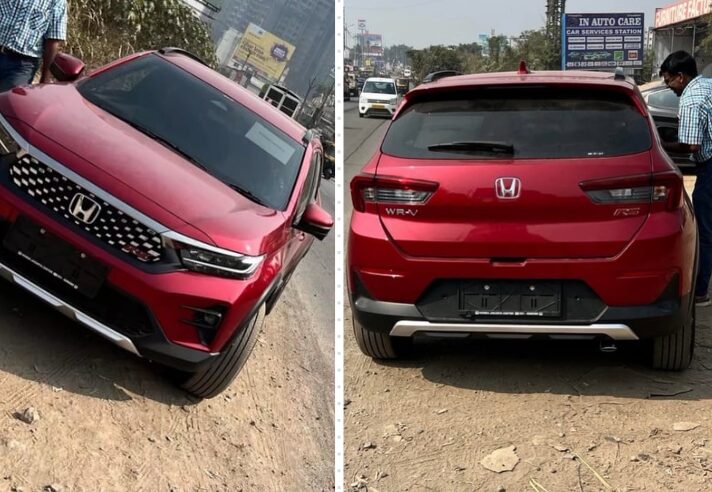
The WRV still looks like a bulked-up hatchback. The model spotted was the RS trim, which is the sportier one. The RS gets many aesthetic touchups over the lower trim to make it look sportier. With the RS, get chrome grille accents, LED DRL headlights, blacked-out roof rails, and 17-inch alloys. Due to its stance and these additional design tweaks, the RS is closer to a hot-hatch than a compact SUV. In the bright-red paint scheme, the RS looks handsome.
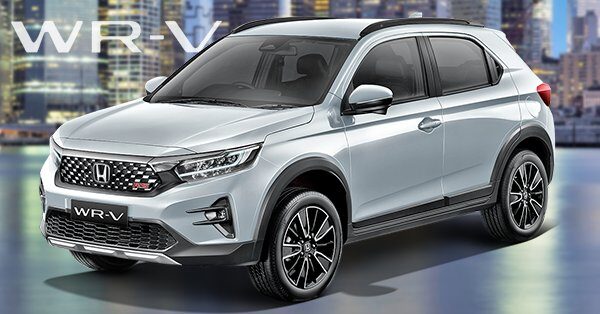
The WRV is also on sale in South Asian markets, which lets us see how the lower trims may look. The base trim seems rather basic. A high stance, sharp cuts and creases across the body are some design features that stand out. The front grille looks similar to those on outgoing Honda models like the City and the Elevate.
The model sold in South Asian markets is 4.06 metres long, which would put it above the sub-4m tax break. The India-spec WRV is expected to be shortened just enough to comply with the norm.
Read More: 4 New Rs 12 Lakh SUVs Launching In 2026!
Cabin
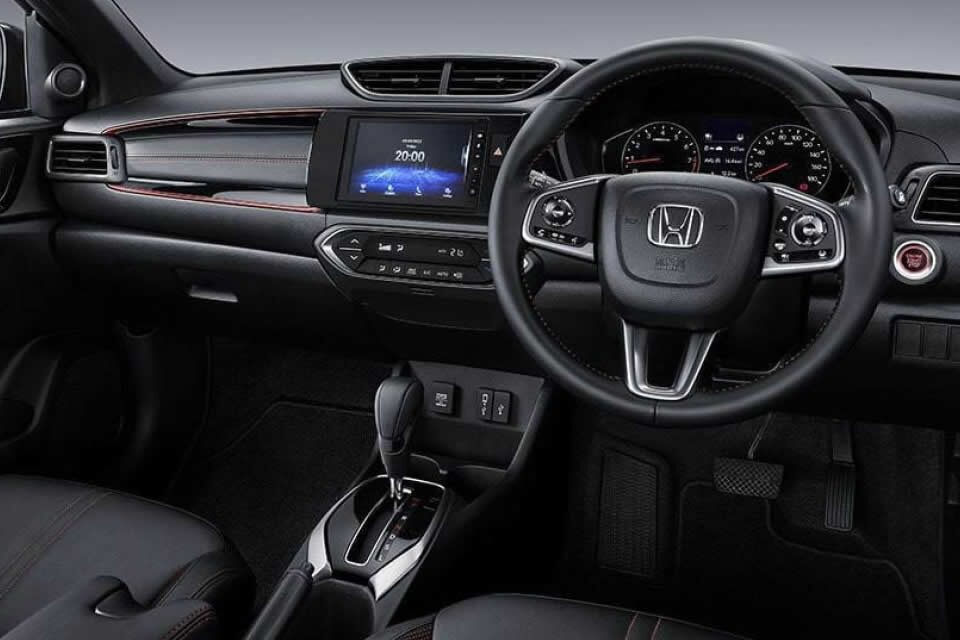
The cabin looks fit for 2021. Compared to some other cars, it seems very outdated. You get a 7″ infotainment screen and a puny 4.2″ TFT driver’s display. Its competitors offer fully digital driver’s screens and much larger touchscreens, some even with a dual-screen cockpit layout. Honda will have to revamp the interiors from the Indonesian-spec WRV to stand a chance against the competition.
The RS trim gets red accents paired with black leather seats, while the lower variants are expected to have a monotonous black theme. The cabin focuses on practicality, which is why you get ample legroom in the back, along with large cubby holes and cup holders.
The feature list for the Indonesian-spec WRV is rather dismal. It misses out on ADAS, panoramic sunroof, ventilated seats and other luxury amenities. The lower models get 4 airbags, while other manufacturers have made 6 airbags as standard. The most recent NCAP tests the WRV underwent were conducted in 2022. It scored 5-stars, which is expected with Honda’s reputation. However, the norms have gotten stricter since then, and Honda would need to make improvements in the safety regard to maintain that rating with Bharat NCAP.
Powertrain
The powertrain options remain quite slim, like with the feature list. There is one engine on offer: the 1.5L iVTEC. This Petrol engine is mated to either a 5-speed manual or the CVT. The Honda iVTEC has been a fan favourite in India since its introduction in the City. Many people buy a Honda just for its dependable engine. The RS trim, despite all its sporty touches, gets no improvement over the 120-horsepower, 145 Nm engine.
Honda may decide to ditch this 1.5L petrol and introduce a smaller 1.2L one to get under the sub-4 4-m tax bracket. The norm states that to qualify for this tax break, cars must be shorter than 4 m and have a petrol engine with a capacity of less than 1.2 L or a diesel engine with a capacity of less than 1.5 L.
Maruti Suzuki is transitioning towards hybrid technology, along with Kia and Hyundai. Honda plans to introduce the hybrid with the WRV as well. Offering a hybrid WRV would be a significant advantage for Honda. Japanese manufacturers would get a tax break because it’s under 4m and a hybrid, allowing them to offer it at an aggressive introductory price. For customers, the hybrid powertrain would improve fuel efficiency.
Rivals
The WRV is expected to compete against the Hyundai Venue, Kia Sonet, Tata Nexon, Mahindra 3XO, Maruti Suzuki Vitara Brezza, Maruti Suzuki Fronx, Renault Kiger, Nissan Magnite and the Hyundai Exter. At the same time, it would compete against premium hatchbacks like the Baleno and i20.
The WRV seems to fall behind all its competitors. If an identical feature list to the Indonesian spec model is released in India, it would be set up for failure. Thus, Honda is expected to make these improvements with the upcoming WRV.
Read More: Kia Sonet Facelift – What to Expect?
Expected Launch and Price
Reports suggest that the WRV will go on sale by early to mid-2026. Honda has become stagnant in the Indian market with minimal car launches in recent years. The current lineup consists of only 3 cars, and Honda is planning a few new introductions, with the WRV being one of them.
The pricing is expected to start at 9 lakh. If Honda equips the WRV with features like ADAS, panoramic sunroof, etc, we could see the RS trim costing upwards of 17 lakh rupees (on-road, Mumbai).
Read More: 2 New Tata Nexon Rivals Launching Next Year!
Image Source
Related Posts
- This was India’s first hot-hatch
- Vinfast to Sell Electric Scooters in India from Q2 2026
- New Honda SUV Spotted In India! » MotorOctane
- Red Bull Challenges Tata’s Legacy
- 4 Major Improvements Expected On New-Gen Kia Seltos! » MotorOctane

Hi, I’m Ravindra Meena , a bike and automobile enthusiast. I share honest reviews, mileage tests, and latest updates about bikes, cars, and EVs to help you make the right choice. Stay connected for real-world insights and trending auto news! 🏍️🚗